
By Our Reporters.
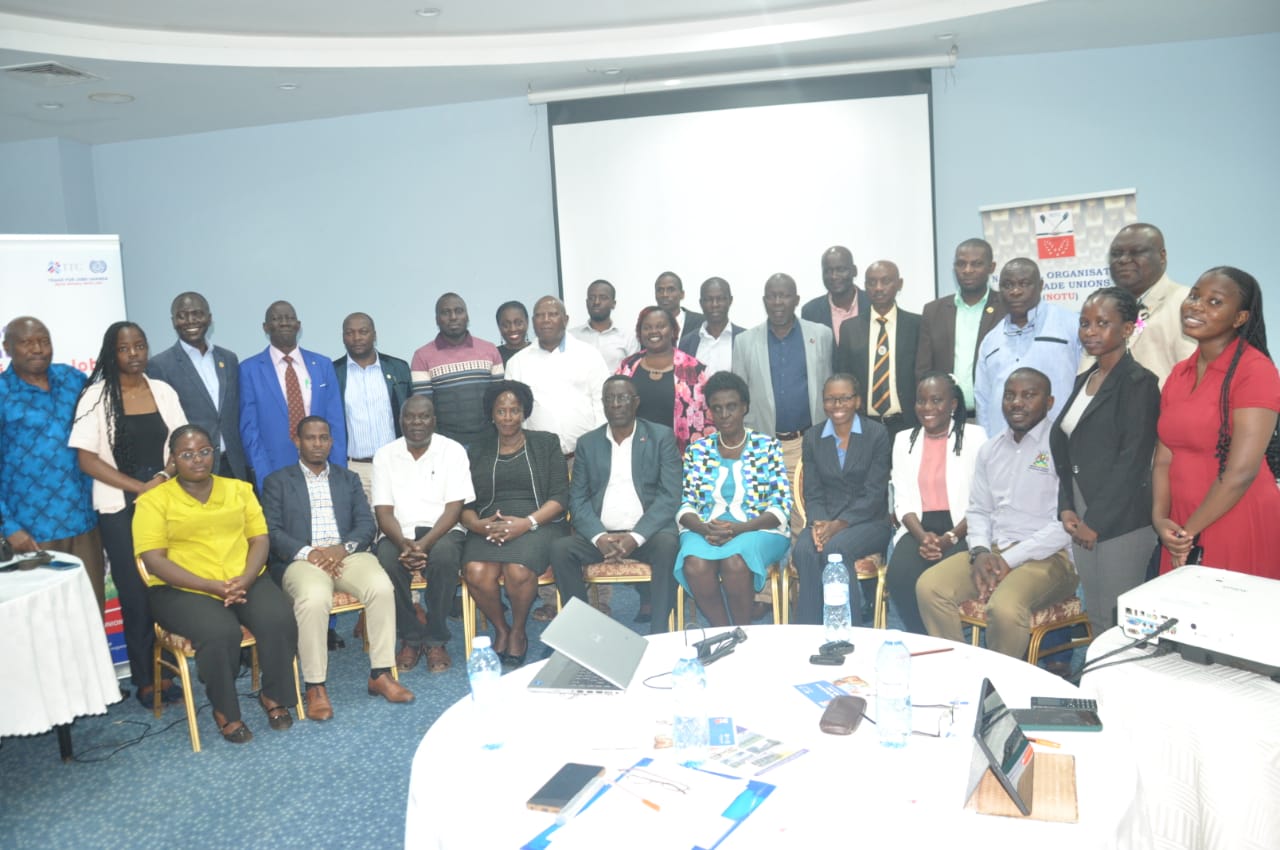
The International Labour Organisation (ILO) held a national validation stakeholders workshop on October 13 -15, 2021 that discussed a media toolkit on “Reporting on Forced Labour and Fair Recruitment at K Hotels, Entebbe.
Participants included United Nations Human Rights Country office, International Migration Organisation (IMO), Ministry of Gender, Labour and Social Development (MGLSD), Ministry of Internal Affairs, National Organisation of Trade Unions (NOTU), Central Organisation of Free Trade Unions (COFTU), Federation of Uganda Employers (FUE) and Externalization of Labour agencies.
Others included the Uganda Media Centre, Uganda Journalists Union (UJU), the New Vision, the Monitor publications, Media trainer Mr John Baptist Imokola. and Consultant Mr Denis Juuko.
The Director for Labour in the Ministry for Labour , Gender and Social Development Hon. Martin Wandera closed the workshop on October 15, 2021. He called on the media to be ethical and responsible in exposing violations of labour rights especially migrant workers.
“ The rights of migrant workers can only be defended if the media plays its rightful roles,” he said.
Below we reproduce excerpts of the media toolkit as presented by Media Consultant Mr Denis Juuko who was the main Trainer.
The document was prepared by Cassandre Gaylord Cyr and Lou Tessier and it was adapted for Uganda by ILO Uganda staff – Jesca Angida and Media Consultants Denis Jjuuko and Charles Autheman.
The toolkit was developed by the International Labour Organization (ILO), a specialized agency of the United Nations which, since 1919, has brought together governments, employers and workers of 187 member states to set labour standards, develop policies and devise programmes promoting decent work.
In the framework of the Fair Recruitment Initiative, the toolkit aims at fostering contributions to the United Nations TOGETHER campaign, promoting respect, safety and dignity for refugees and migrants, and to the 50 for Freedom campaign, which aims to mobilize support for the ratification of the ILO Forced Labour Protocol.
It also aims to further contributions to Alliance 8.7, the global partnership committed to achieving Target 8.7 of the Sustainable Development Goals on eradicating forced labour, modern slavery, human trafficking and child labour around the world.
Many organizations and actors have contributed to the toolkit, including the International Federation of Journalists (IFJ), ILO staff in various country offices and journalists from many countries around the world.
The Media-Friendly Glossary of the toolkit was developed with the United Nations Alliance of Civilizations (UNAOC) and is under joint copyright.
The ILO Media Toolkit was prepared by Cassandre Gaylord Cyr and Lou Tessier. The toolkit was originally developed by Charles Autheman, Kevin Burden, Jane Colombini, Maria Gallotti and Lou Tessier based on the lessons learned from several media engagement programmes of the ILO and other agencies as well as building on the wealth of experience of the IFJ.
According to Mr Denis Juuko Journalists have a voice that many people do not, and they have the ability to shine a light on abusive practices and denial of fundamental human rights as well as to alert readers or viewers to the abuses.
Journalists have the opportunity to change public opinion, even policy, impacting on the lives of workers. In addition, journalists have a clear ethical duty not to make matters worse, which can happen when reporters and editors use derogatory language for workers and sensationalist headlines.
“Writing stories on a human rights issue such as forced labour and fair recruitment is not like writing a routine news story. It takes more time because of the effort required to investigate: speak to a variety of sources; weigh; and verify them in the process,” he said.
The consultant hastened to add that many stories of forced labour and fair recruitment have a local impact and produce repercussions globally. He said :” For instance, workers who are trapped in the garment industry may be producing clothing that some of your readers wear. Therefore, understanding contemporary economic interactions and global production mechanisms are also important for the reporting.”.
Labour migration is multifaceted involving rural to urban migration in search of employment but also increasingly urban to rural (as workers on farms) or second cities and urbanizing areas. Many Ugandans also migrate outside the country for work. Originally, Ugandans migrated to north America, western Europe and Japan for what is commonly known as kyeyo. Today, there is an increasing number of Ugandans migrating to the Arab states seeking for work. However, Ugandans also migrate to neighbouring countries especially Kenya, South Sudan and for some time Rwanda and Burundi.
Uganda hosts approximately 1.4 million refugees mainly from neighbouring countries. Uganda is currently pushing its Vision 2040—promoting notably industrialization and is observing an increasing number of migrant workers from Asia, mainly India, Pakistan and China. In 2012/13, the government of Uganda issued 9,161 working permits for migrant workers. As Uganda pushes its Vision 2040 that among other sectors promotes industrialization, there is a large number of migrant workers from Asia, mainly India and China.
Many of these Ugandans especially those migrating to Middle Eastern countries, are often connected through private employment agencies. According to an assessment by ILO, the reasons for increasing number of Ugandans leaving the country for work are linked to high population growth, youth unemployment, low wages, and the demand for labour in destination countries.
Concomitantly, Ugandan migrant workers, especially women, have been exposed to exploitation and human trafficking in these flows. The Trafficking in Persons Report (2021) by the United States of America State Department reveals that there is an increased number of Ugandans being trafficked for commercial sex work and or labour exploitation to countries such ,as Poland, Hong Kong, China, Netherlands, Norway, and the Middle Eastern countries like Jordan, Kuwait, Qatar, Oman, and United Arab Emirates.
The report shows a high number of cases while noting that government is more likely to prosecute sex trafficking cases than those involving labour migration. Young people are the most at risk group with young women forming a large number as they usually seek employment as domestic workers in Kenya and the Middle East. School closures in 2020 due to COVID-19 have increased the vulnerability of children and young people to forced labour and human trafficking.
Many of these workers are exploited by paying recruitment fees and associated costs: excessive arrangement fees to cater for passports and other travel documents, transport costs such as air tickets etc.
The media has a key role to play in exposing these abuses. Dedicated reporting about labour migration and unfair recruitment practices can mitigate these practices that denigrate humanity.
The toolkit aims to foster contributions to the United Nations TOGETHER campaign, promoting respect, safety and dignity for refugees and migrants, and to the 50 for Freedom campaign, which aims to mobilize support for the ratification of the ILO Forced Labour Protocol.
Forced labour can take many different forms. Victims are often tricked into jobs where they are paid little or nothing at all and they cannot leave because they have been manipulated into debt or had their identity documents confiscated. Poverty, illiteracy, discrimination and migration are some of the factors that make workers more vulnerable to forced labour.
A. What Is Forced Labour?
The term forced labour covers a wide variety of coercive labour practices where work is extracted from individuals under the threat of penalty. People who are in forced labour did not give their free and informed consent to start working and or are not free to leave their work. Human trafficking, debt bondage, bonded labour, slave labour and modern-day slavery are terms that are used by news and media to describe forced labour situations. There are an estimated 24.9 million victims of forced labour around the world. The ILO says forced labour can be found almost anywhere, whether that is in Asia and the Pacific, Europe, Central Asia, Africa, the Arab States or the Americas ■