

By Our Reporters.
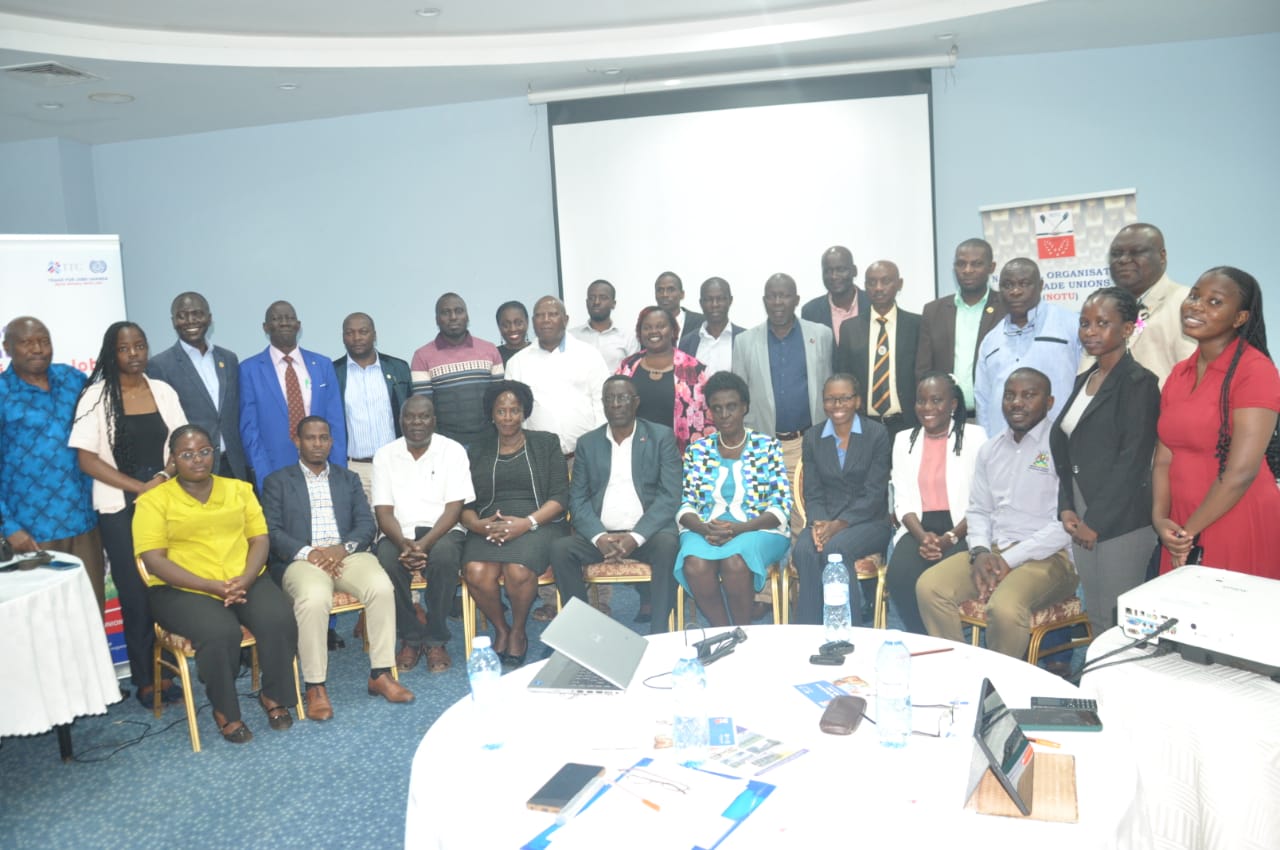
A Research study was commissioned by the National Organization of Trade Unions (NOTU) and undertaken by Consultants Mr Kakaire Abdu and Mr Baligasima Yazid.
The study set out to assess the effect of presidential directives on COVID-19 pandemic on industrial relations amidst the Covid-19 pandemic. It specifically assessed the effect of presidential directives on Covid-19 on implementation of Collective Bargaining Agreements (CBAs) in organisations amidst covid-19.
The study also assessed effects onrepresentation of workers in organizations, the workers organizing and recruitment of members into the trade unions and on the workers’ freedom to associate and assemble, and social protection of workers in Uganda
Two methods of data collection were applied including document or content analysis and interviewing methods to collect qualitative data. The interview method was used to collect data from General Secretaries and members of some Labour unions affiliated to National Organisation of Trade Unions (NOTU).
Thematic analysis method was used to analyse data collected from secondary data sources which was then collaborated with the interview responses got from the different respondents before drawing conclusions.
Results of the study generally show that unions had a number CBAs running by the time Covid-19 broke out but many were adversely affected by the Presidential directives. The effects of the Presidential directive on Covid-19 varied from organisation to organisation with those who were seriously affected being those in companies whose services were regarded non-essential. Research findings show that workers’ representationn, organization and recruitment, workers’ freedom of association and assembly, as well as the workers’ social security/ or protection were adversely affected.. But the effects varied from company to company with those whose services were dubbed non-essential being affected most.
The study therefore generally recommended a number of measures which need to be undertaken by the three stakeholders to address the challenges created by the Covid -19 pandemic.
NOTU Secretary General Hon. Werikhe Christopher Peter provided unconditional support while General Secretaries and members affiliated to the labour centre participated and ensured the research was successful.
According to the report the Presidential Directives on Covid-19 Pandemic directly and indirectly affected work relationships and industrial relations that prominently stood out. The restrictions potentially threatened the already fragile economic recovery from the effects inflicted by lockdowns on the country’s economy.
The adverse effects included those that led to total or partial closure and the suspension of business operations like on public transport covering taxis, coasters, buses, passenger trains, tuku – tukus, and motorcycle taxis popularly known as boda bodas. But later boda bodas were restricted to carrying only cargo and allowed to operate up to 2:00 pm and later up to, 6:00pm.
Those allowed to operate except for cargo trucks, ambulances and private transport for essential service providers, were Conferences, workshops, seminars and generally public gatherings were banned.
Government Instituted curfews which limited peoples’ movements, suspended privately owned vehicles which had earlier been allowed to move but with very strict guidelines, for flouting the Covid-19 directives.
As if that was not bad enough government suspended weekly and monthly markets that included cattle auction markets and food markets and closure of non-food sellers including shopping arcades, hardware shops, salons, lodges and garages. This means all the closures jobs were lost and workers rendered redundant. The situation was made worse by the closure of all schools and institutions of higher learning rendering all teachers redundant and unemployed. The non-essential service providers many of whom belonged to the private sector were disenfranchised and thrown out of jobs.
According to the findings some of the interviewees expressed dissatisfaction with the presidential directives on Covid-19 because it adversely affected their CBAs, while some were able to evade gross effects. But trade unions were able to improvise, innovate and come out with new negotiations for better terms of service and improve their lives.
The Federation of Uganda Employers (FUE) encouraged its members who had recognized and worked with labour unions to engage and come-up with agreeable solutions to labour related problems including termination, forced leave with and or with no pay.
However the suspension of both public and private transport and gatherings of more than five people by the presidential directives on Covid-19, meant the workers’ representatives could not easily engage employers to avoid spreading the pandemic.
Meanwhile, a report by the United Nations in Uganda also reported that many formal enterprises were not in position to sustain their operations for more than three months on their current cash flow after the presidential directives to lockdown due to Covid-19.
It is further reported that only 15 % of the formal enterprises could sustain their operations on the current budgets or cash flow. The presidential directives on Covid-19 which restricted movements and gatherings denied many employees opportunity through their representatives to engage in discussions with employers leading to loss of jobs (United Nations in Uganda, 2020).
According to the report by Margini et al (2020) titled “the Initial Covid-19 response in Uganda” indicated that Covid-19 disrupted the country’s essential health system, social services and exacerbated gender-based violence in society. This affected the delivery of key basic services and essential public health functions. The same report indicated that the lockdown had severe negative implications on the earnings of especially the urban poor, mainly those in the informal sector. Similarly, the International Labour Organization (ILO) reported that an estimated 2.7 billion workers, representing 81% of the world’s workforce was affected by both full and partial lockdowns. The same report shows that many of these workers were asked to go on forced leave and take no or half pay, while the other workers’ contracts were not renewed.
Most worketrs especially those who work with the private sector, employed in companies that provide services were regarded non-essential and forced to work from home.
The Presidential directive led to both partial and full lockdowns, as well suspension of a number of pertinent services to workers led to unemployment. The same report shows that the rate at which people lost jobs due to lockdowns heightened the demand by workers through their representatives at different levels for government to provide financial benefits to workers who were adversely affected by the measures.
The report shows the prevailing circumstances resulted into amendment of the National Social Security Fund (NSSF) Act to facilitate workers who had saved with the fund for 10 years and who were 45 years or over to access partial payments of 20 % their savings. The same law allows persons with disabilities who have saved with the fund for over 10 years and are 40 years and above, to access 50 % of their savings. This is aimed at helping them support their families and other dependents.
The bill was assented to by H.E the president of Uganda on 2nd of January, 2022 and became law upon publication in the Uganda gazette on 7th January, 2022. This was largely seen as the New Year gift for the workers since many had lost their jobs and suffered negative impacts due to covid – 19 pandemic■