



By Our Reporter
Happy World Earth Day 2023: THEME: “Invest in Our Planet,” writes Hon. Dr Abdulhu Byakatonda International Mother Earth Day provides an opportunity to raise global public awareness of the challenges to the well-being of the planet and all the life it supports. The Day also recognizes a collective responsibility, as called for in the 1992 Rio Declaration, to promote harmony with nature and the Earth, to achieve a just balance among the economic, social, and environmental needs of the present and future generations of humanity.
The UN General Assembly (UNGA) designated 22 April, as International Mother Earth Day through resolution A/RES/63/278, adopted in 2009.
In a world of 9.5 billion people, global demand for food, fiber, and biofuels has to be met with minimal possible increases in land, water, fossil fuels, and the minerals used to produce fertilizers. The problem is debated at three levels: first, that agriculture will not be able to produce enough because it will come up against both biophysical and environmental limits that restrict yields; second, that the need to expand and intensify agriculture will destroy the broader environmental values of forests, wetlands, marine systems, and their associated biodiversity; and third, that there are institutional obstacles to the diffusion and adoption of the innovations that could solve these problems.
Although there is debate on these issues, there is also strong consensus that we are witnessing unprecedented changes in our major agricultural systems. Major shifts are occurring in the way food and other agricultural commodities are produced, in the scale at which this happens, in the geographical locations of agriculture, and perhaps most notable, the agencies and actors driving these processes. Growth in demand for agricultural products will mainly occur in markets of emerging economies like Uganda. Therefore, the ways in which we respond to growing food demand will be major determinants of environmental change at a global scale. I have always highlighted innovations in agriculture that could contribute to producing more food without increasing environmental pressures, how agricultural science is responding to environmental challenges.
Agricultural land is now required to deliver multiple environmental and production services. The issues are often beset by “wicked problems” where different communities of scientists and practitioners are unable to agree on the framing of questions and therefore advocate divergent solutions. Agricultural innovation is essential to address environmental problems in a world that must soon support more than 9 billion humans. Poverty and food insecurity go hand in hand. For the 2 billion malnourished poor in developing countries, shortterm food security is inevitably a higher priority than long-term environmental sustainability. A large proportion of rural poor live in regions with marginal land and climate for agriculture or in areas with more favorable climate that lie at the interface between agriculture and remaining carbon-rich and biodiverse natural ecosystems such as rainforests, wetlands, grasslands, and savannas. Feeding 9 billion people and lifting rural poor out of poverty is a prerequisite for maintaining the planet’s environment. Many people are leaving rural areas and seeking employment in manufacturing and services in cities.
However, this opportunity is not open to all. Large numbers of poor farmers continue to practice extensive agriculture. Inevitably they will continue to encroach on hitherto uncultivated lands unless they can adopt innovative systems that allow for agricultural intensification and development of agricultural equipment industries, farm inputs, and food processing capacities. To this end, much agricultural research continues to focus on how to increase productivity on this existing farm land. Improved efficiency in the use of land and agricultural inputs is
already contributing to environmental
goals. Quantifying food production
capacity of currently farmed land has
focused on estimating “yield gaps”
(i.e., the difference between current
farm yields and the potential that can
be achieved with good crop and soil
management).
However, increasing productivity
is necessary but not sufficient to
ensure food security, reduce poverty,
improve nutrition, and maintain the
natural resource base for sustainable
development. Innovations across
a broader spectrum of policies and
technologies are needed to confront
the complex array of challenges at the
agriculture–environment nexus.
Reliance on use of nitrogen fertilizer
to support high yields is perhaps
the Achilles heel of modern crop
production. Nitrogenous fertilizer
is essential for modern agriculture,
and the lack of access to it is a major
obstacle to yield increases in Africa.
However, its misuse has negative
impacts on water quality and climate
through emissions of nitrous oxide, a
greenhouse gas (GHG) 300 times more
potent in global warming impact than
carbon dioxide.

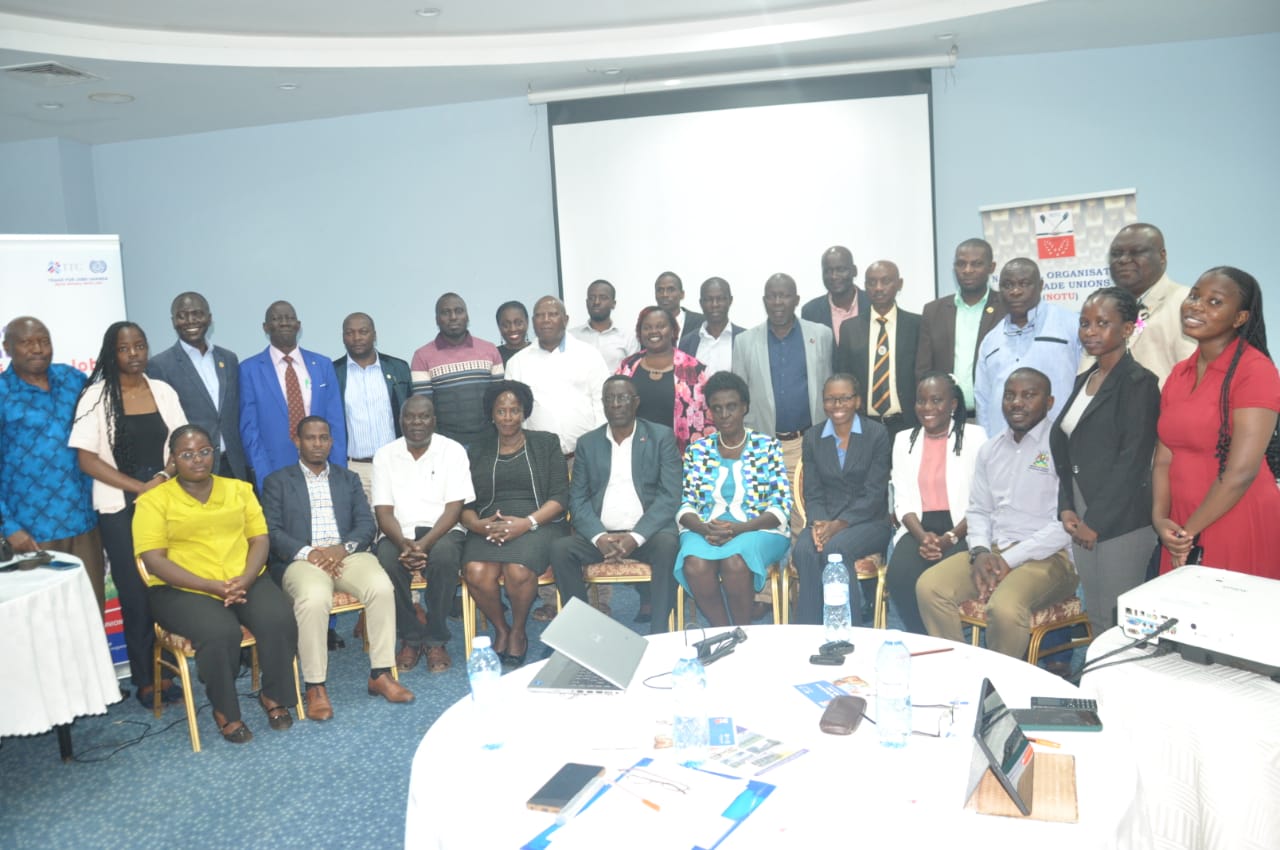
Agriculturalists in training courtesy Workers MP Hon. Abdulhu Byakatonda
Industrial production of reactive
nitrogen, mostly used to fertilize food
crops, now exceeds the global total
produced from all natural sources.
Although atmospheric N2 is relatively
inert, reactive nitrogen, including
ammonia, nitrate, and organic forms
including nucleic and amino acids,
and other amines and amides are
required as building blocks of all
living organisms.
Fish are vital sources of food for
many of the world’s people, both
rich and poor. Conventional wisdom
holds that the move to intensive
aquaculture to meet burgeoning
demand is inevitable. Fish would
therefore join trees and commodity
agricultural crops in being produced
in intensive industrial systems,
and harvesting from near natural
ecosystems would become less
important. Natural aquatic systems
can yield multiple products and
values so perhaps the juggernaut of
intensification and simplification will
not always overwhelm traditional
diverse production systems.
Timber and environmental
services from managed natural
forests diverse products and services
from agroforests, and mosaics of
production and conservation uses
may represent alternative scenarios
for the agriculture–environment
nexus.
Food production and nature
conservation will compete for the
same land. Many tradeoffs are best
addressed at these meso-scales, and
much progress is being achieved
through integration of multiple uses
in mosaic landscape. Achieving
better outcomes at this scale has
been difficult for existing sectoral
institutions, but the solution is not to
replace those institutions but rather to
facilitate the interactions among them
and equip them to negotiate between
conflicting and competing goals.
Agricultural technologies are
becoming more resource use efficient.
There are rapid improvements in
achieving fertilizer use efficiency.
Intensification has and will
continue to allow land to be saved,
and land use mosaics will allow
multifunctionality to be achieved.
Agricultural and fishery systems that
include biodiversity will continue to
be important.
However, significant challenges
remain. Tradeoffs between
intensification and extensification
are poorly understood, and we lack
robust, spatially explicit models to
guide policies governments could
use to properly direct the form and
location of future agriculture that
meets food demand while conserving
natural resources.
The conclusion that emerges is that
a radical rethink is needed in the
orientation of agriculture.
Research has to underpin
innovations that will allow more
food, fiber, and biofuel to be produced
but in ways that alleviate rural
poverty, improve diets and health,
and allow increases in stocks of the
environmental assets upon which all
depends.
Progress towards these four goals
requires new ways of organizing
research, new ways of setting
priorities, and more subtle ways of
assessing outcomes and impacts.
The solutions will not be narrow
sectoral or technical innovations but
nested sets of innovations at the scale
of the plant, the agronomic system,
the landscape, and the institutional
environmentr■