
BY BAKWERANE TONNY AND ALVIN OUMA
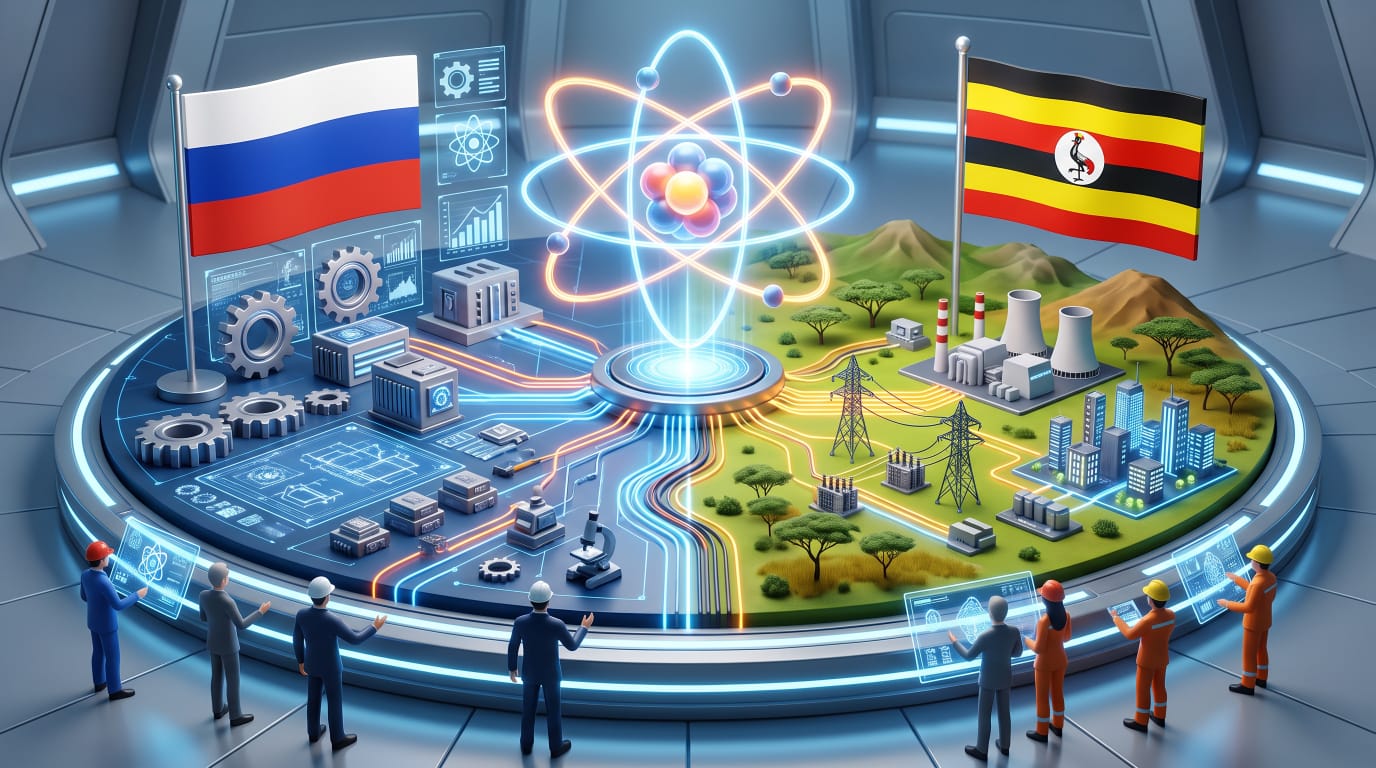
Uganda and Russia are seeking to strengthen longstanding partnership through enhanced cooperation in the field of energy, technology, trade, and human capital development.
This follows a high – level roundtable discussions by officials from the two countries in Kampala. The dialogue, hosted by New Vision on October 7, brought together government officials, researchers, and industry experts to discuss strategic areas of collaboration, with particular emphasis on energy security, nuclear power development, industrialization, and knowledge transfer.
The discussions were attended by Russian Chargé d’Affaires ad interim to Uganda, Sergey Lobanov; Senior Energy Specialist in Uganda Nuclear Energy Department, Damalia Noel Abbo Ofumbe, Russian academic and Africa specialist Prof. Denis Degteev; Rosatom representative and BRICS Nuclear Platform Coordinator Elsie Pule; and Herbert Kafiro, Deputy Executive Director of the Southern and Eastern Africa Trade Information and Negotiations Institute (SEATINI).
The discussions underscored a shared aspiration to build a partnership that extends beyond traditional trade and commodity exchange towards long-term industrial cooperation, technology transfer, and sustainable capacity building.
Building on Six decades of relations opening the discussion, Lobanov reflected on the enduring ties between Uganda and Russia, noting that diplomatic relations were established on October 13, 1962 shortly after Uganda attained Independence.
Lobanov noted with optimism that the discussions between Rosatom and Uganda’s Ministry of Energy and Mineral Development would be fruitful, adding that discussions on peaceful application of nuclear technology would progress.
He said the forthcoming high – level Russian – Africa summit in Moscow would provide another big opportunity to advance dialogue in areas such as energy, trade, science and technology.
The roundtable comes ahead of the Third Russia-Africa Summit scheduled for October 28-29, 2026, in Moscow, where leaders and stakeholders are expected to explore cooperation in key sectors including energy, digital technologies, artificial intelligence, finance, and innovation.
Speaking on Uganda’s long-term energy strategy, Abbo Ofumbe outlined the country’s ambitious plans under the 2023 Energy Policy, which targets electricity generation of 52,000 megawatts by 2040.
According to Ofumbe, nuclear energy is expected to play a significant role in achieving this objective, contributing approximately 24,000 megawatts to the country future energy mix.
She noted that changing climatic conditions and increasing energy demand have reinforced the need for diversification.
“While hydropower remains an important component of Uganda energy sector, the country’s development aspirations require a broader and more resilient energy portfolio. Nuclear energy presents an opportunity to provide reliable baseload power in support of industrialization and economic growth,”; she said.
Uganda has identified potential sites for a nuclear power plant, including Buyende, Nakasongola, Lamwo, and Kikuube, with further technical assessments and planning processes underway in collaboration with international partners.
Ms Ofumbe said discussions with Rosatom have continued to advance, guided by bilateral agreements signed over recent years, including a Memorandum of Understanding in 2017 and an intergovernmental agreement concluded in Vienna in 2019.
Current plans envision a 7,200-megawatt nuclear power facility comprising six reactors, each capable of generating approximately 1,200 megawatts.
Advancing Development Through Peaceful Nuclear Technologies
Beyond electricity generation, Ms Ofumbe highlighted the wider developmental applications of nuclear science and technology.
She pointed to ongoing initiatives supporting cancer diagnosis and treatment at the Uganda Cancer Institute, as well as applications in agriculture, food safety, and animal health.
“Nuclear technology is not only about power generation. It is also a valuable tool in healthcare, agriculture, research, and food security,” she said.
She said:” Human resource development remains central to Uganda’s nuclear
Programme and local expertise would be essential for the long-term sustainability of future projects. A key priority is ensuring that Ugandans acquire the knowledge and skills necessary to manage, operate, and maintain these facilities over the long term.”
A Shift Towards Long-Term Economic Partnerships
Prof. Denis Degteev said the evolving nature of Russia-Africa relations reflects a growing emphasis on production partnerships, industrial cooperation, and technology sharing.
He argued that large-scale infrastructure and energy projects have the potential to support Africa’s broader industrial transformation agenda.
“Nuclear energy has the capacity to provide the reliable and substantial electricity supply required to support industrial development and economic modernization across the continent,” he said.
Mr Degteev also highlighted opportunities within the East African Community, noting that regional cooperation in energy infrastructure and value addition could help unlock greater economic benefits.
He expressed support for initiatives aimed at ensuring that Uganda’s natural resources contribute more significantly to domestic industrial development and regional trade.
Energy as a Strategic Development Imperative
For Kafiro, energy remains a central pillar of Uganda’s economic ambitions.
Energy is a matter of national economic security he said. Uganda is to achieve its
industrialization goals and realize its long-term development aspirations, access to reliable and affordable energy will be critical;
He encouraged a balanced approach to nuclear energy development, emphasizing its potential contribution not only to electricity access but also to agriculture, healthcare, and industrial productivity.
Kafiro further called for efforts to strengthen trade relations through increased value addition and expanded market access, arguing that deeper economic cooperation should deliver benefits for both countries.
He advocated a coordinated approach involving government institutions, the private sector, farmers, and industry stakeholders to maximize the opportunities arising from Uganda-Russia engagement.
In closing, Lobanov welcomed the constructive exchange of views and reaffirmed Russia commitment to strengthening cooperation with Uganda.
He said:” Such discussions help us identify new opportunities for collaboration and deepen mutual understanding. We believe there is considerable potential to further expand our partnership for the benefit of both countries,” He said.
As Uganda advances its development agenda and seeks to diversify its energy landscape, participants agreed that strengthened international partnerships and sustained knowledge exchange will be critical to achieving long-term economic transformation and energy security.
ends