





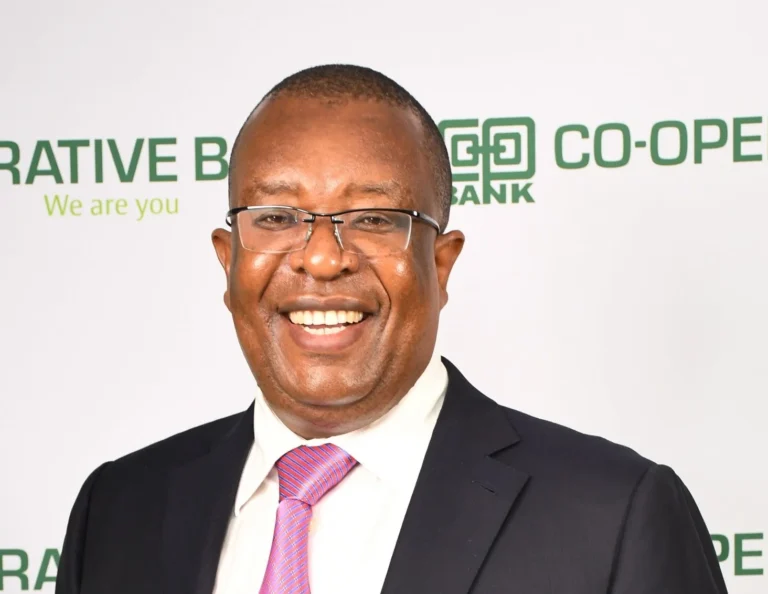
Co-operative Bank of Kenya’s AGM on May 16, 2025, will approve a KSh1.50 ($0.011) dividend per share, totaling KSh8.8Bn ($65.1M), with assets at KSh743.2Bn ($5.5B).
The Co-operative Bank of Kenya (Co-op Bank) is set to hold its eagerly anticipated Annual General Meeting (AGM) on May 16, 2025, a gathering expected to both celebrate a year of stellar performance and chart new growth directions amid a dynamic banking landscape.
At the heart of this year’s AGM is a resounding show of confidence: a proposed final dividend of KSh1.50 ($0.011) per share, amounting to a whopping KSh8.8 billion ($65.1 million) in total payouts to shareholders. This generous disbursement, backed by strong full-year earnings and robust asset growth, underlines Co-op Bank’s consistent commitment to value creation and its dominant presence in Kenya’s banking sector.
“This dividend speaks to our disciplined strategy, our cooperative model’s resilience, and our commitment to sustainable growth,” said Gideon Muriuki, the Group Managing Director and CEO, during the release of the bank’s latest financial results.
The dividend comes on the back of a record KSh743.2 billion ($5.5 billion) in total assets, positioning Co-op Bank as one of the largest financial institutions in the region. This milestone reaffirms the lender’s solid foundation, strategic prudence, and deep community roots.
Founded on the co-operative movement model, Co-op Bank has long stood out for its customer ownership structure—boasting over 15 million account holders, many of whom are members of co-operative societies, saccos, and community-based groups. Its reach into grassroots Kenya has enabled it to maintain financial inclusion as a core business driver.
The upcoming AGM is not just a ceremonial ritual—it’s a crucial corporate governance event where shareholders will:
- Approve the 2024 audited financial statements
- Vote on director appointments and remuneration
- Endorse the KSh1.50 ($0.011) dividend per share
- Receive insights into the bank’s growth plans across Kenya, South Sudan, and the digital banking frontier
Held virtually in recent years, the 2025 AGM will likely continue the hybrid model—offering both physical and digital attendance options to accommodate the bank’s vast shareholder base. It comes at a time when shareholders are increasingly focused not only on profits but on long-term sustainability and regional expansion.
The bank’s profit before tax for 2024 stood at KSh36.8 billion ($272 million)—a significant year-on-year increase, driven by growth in net interest income, digital banking uptake, and a cautious lending strategy that tamed non-performing loans. It’s this strong financial muscle that allows the bank to reward shareholders handsomely even as it reinvests heavily in technology and risk management.
“We are investing for the long haul—digital transformation, compliance, and regional integration are key pillars of our vision,” added Muriuki, who has managed the bank since 2001.
Even with the generous payout, Co-op Bank continues to maintain one of the industry’s healthiest capital adequacy ratios, providing the cushion needed to navigate macroeconomic uncertainties—from interest rate volatility to currency depreciation.
What makes Co-op Bank particularly unique is its ownership model: the Co-operative Bank Holdings Co-operative Society holds the majority stake, aligning the institution’s success with the broader prosperity of Kenya’s co-operative movement.
As Kenya’s financial landscape evolves—with new fintechs, climate financing, and ESG expectations reshaping the terrain—Co-op Bank’s 2025 AGM will be watched closely. Stakeholders want to hear how the bank plans to maintain its dominance while adapting to shifting consumer behavior, tightening regulations, and regional opportunities.
From a dividend perspective, the KSh8.8 billion ($65.1 million) payout offers an attractive yield for retail and institutional investors alike, particularly in an environment where many lenders have taken more conservative dividend positions.
The performance of its key subsidiary Kingdom bank, its operations in Juba, South Sudan, will also be closely scrutinized by financial watchers keen on assessing growing customer base against digital transformation provided by online banking contrasted against the growing political uncertainty in Juba where the lender holds a major stake in the bank.